

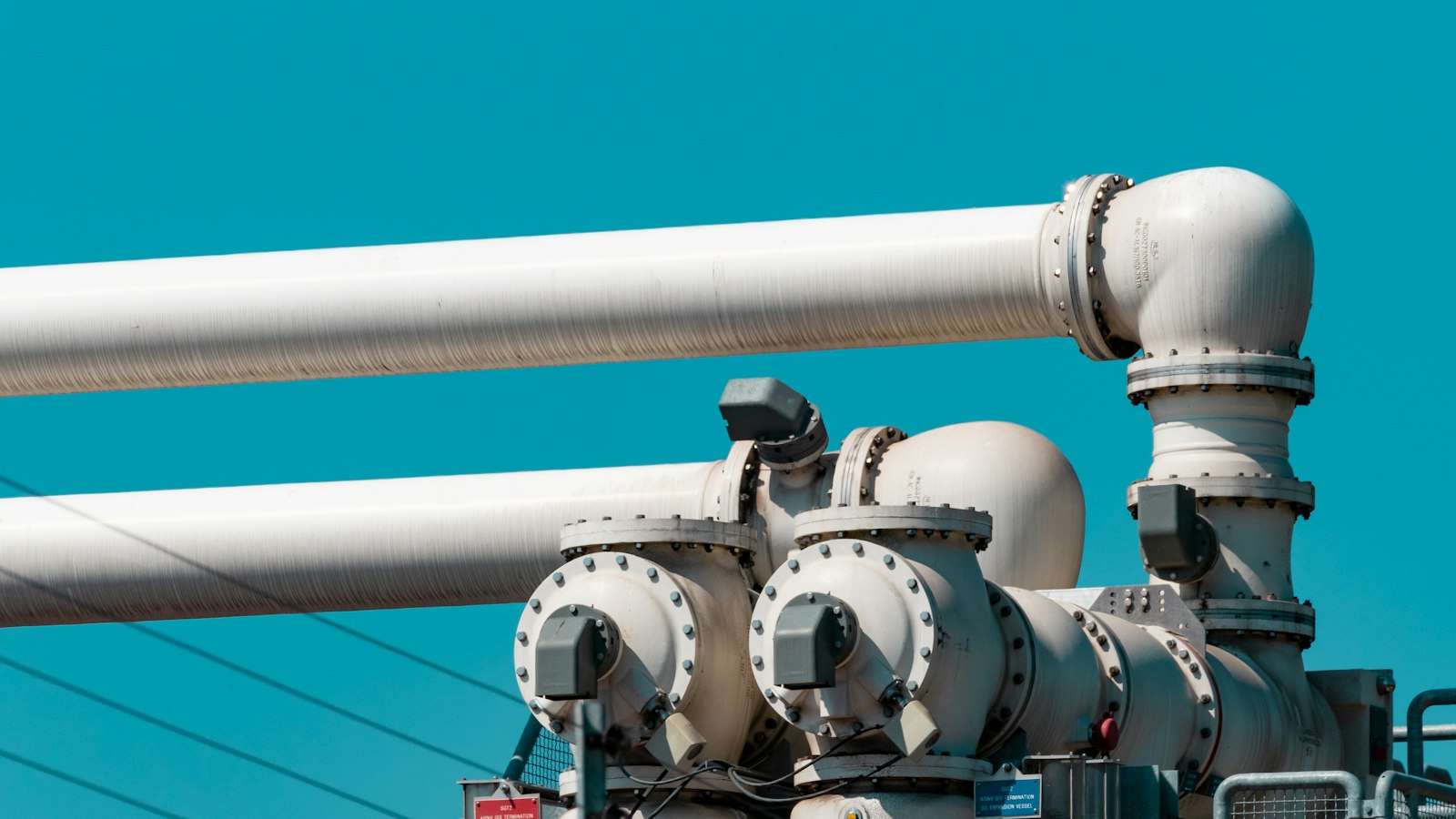
Chlorine gas piping needs two different material strategies on one plant. Dry chlorine at ambient temperature does not attack carbon steel, so dry gas lines are normally steel. Wet chlorine, upstream of the drying section, forms hydrochloric and hypochlorous acids and corrodes carbon steel and stainless steel quickly, so wet lines use lined steel, non-metallic pipe or titanium. A material that is right on one side of the drying towers can be dangerous on the other, which is why both sides and the joints between them are covered here.
Why dry and wet chlorine need different materials
The difference is water. With moisture present, chlorine hydrolyses to hydrochloric acid and hypochlorous acid. That mixture is oxidising and acidic at the same time, which defeats the passive films that protect stainless steel and most alloys.
Dry chlorine behaves differently. At ambient temperature it forms a thin, stable film on carbon steel and corrosion is negligible. That stops being true if moisture gets in, and at elevated temperature, where steel can react with chlorine. The Chlorine Institute’s Pamphlet 6, “Piping Systems for Dry Chlorine”, is the common reference for these limits.
Titanium is the reverse case. It performs well in wet chlorine but can ignite in dry chlorine. It must stay on the wet side.
Euro Chlor’s materials guide puts the boundary at less than 20 mg of water per kg of chlorine for gas treated as dry, and lists steel as the usual material for it. The same guide notes that tantalum is the only metal usable without restriction in both wet and dry chlorine, which in practice limits it, on price, to small parts.
Where wet chlorine occurs
Wet chlorine runs from the cell outlets to the inlet of the drying section:
| Line section | Chlorine condition | Common material families | Notes |
|---|---|---|---|
| Cell outlets and wet chlorine headers | Wet, near cell temperature, saturated with water vapour, slight pressure or suction | FRP, fluoropolymer lined FRP, fluoropolymer lined steel, titanium | Large bore and low pressure suit FRP and lined FRP |
| Chlorine coolers and condensate lines | Wet gas plus chlorine water | Titanium, fluoropolymer lined steel, lined FRP | Condensate is one of the most corrosive streams in the plant |
| Mist eliminator to drying tower inlet | Cooled wet chlorine | Lined steel, FRP | Brine mist carry-over must be removed here |
| Drying tower outlet onwards | Dry gas | Carbon steel to plant standard | Moisture ingress turns it wet |
| Compressor discharge and liquefaction | Dry gas and liquid, higher pressure | Carbon steel to plant standard, low-temperature steel where needed | Liquid sections need low-temperature toughness |
| Vent and tail gas lines to absorption | Often dry at source, wet near the scrubber | Lined steel or FRP near the scrubber | The line crosses the boundary |
Fluoropolymer lined steel on chlorine lines
Lined steel combines a steel pressure boundary with a polymer liner that carries the chemistry. GreyTec’s lined metal pipe page states that PTFE and PFA resist gases such as chlorine and H2S that corrode steel. Published resistance data agrees: Zeus Inc rates PTFE, FEP and PFA resistant to dry and wet chlorine at 20, 60 and 100 °C.
Two properties of the liner matter on chlorine:
Permeation. Chlorine and hydrogen chloride permeate fluoropolymers slowly. PTFE is more permeable than PFA and FEP. Over years, gas that permeates the liner can reach the steel, condense with moisture and corrode it from the inside. Lined pipe vent holes let permeated gas escape and give a visible warning.
Temperature and vacuum. Wet chlorine headers often run close to atmospheric pressure, and some sections run under slight suction. The liner type and its anchoring must be rated for any vacuum the line can see, including during shutdowns and cool-down.
Flange and joint leak points
Most chlorine leaks on a sound pipe system start at joints.
- Liner flares on lined pipe. The flared liner is the sealing face. Misalignment and over-torque crack or extrude it.
- Bolt load after thermal cycles. Polymer flares relax with temperature cycling. Torque that was right at installation may not hold after the first heat-up.
- Gaskets on dry chlorine steel lines. Gasket materials must be compatible with chlorine and free of oils.
- Material transitions. Joints between FRP and steel, or lined and unlined pipe, need careful design of flanges, bolting and gaskets.
- Instrument connections and small bore branches. These are often the weakest point on a wet chlorine header.
What to inspect
Dry chlorine steel lines: wall thickness at low points where moisture could collect, external corrosion under insulation, and flange condition. Any internal corrosion product on a dry line means moisture is entering.
Wet chlorine lined lines: vent holes for staining or wetness, liner flares at opened joints, and spark testing of the liner when the line is open. On FRP, look for discoloured or soft inner surfaces and blisters.
At the boundary: spools near the drying section outlet, where upsets can carry wet gas or acid mist into the dry section.
Where chlorine gas piping goes wrong
- Moisture enters the dry section. Hydrotesting, washing or a poorly isolated opening leaves water in a dry line. Dry chlorine systems are normally tested and dried to the plant’s own procedures before chlorine is introduced.
- Titanium is installed downstream of drying. A spare spool or instrument part made for the wet side ends up on the dry side.
- Liquid chlorine reaching FRP. FRP that handles wet chlorine gas can be destroyed by liquid chlorine. One published case describes a vinyl ester pipe in chlorine gas, occasionally exposed to liquid, that lost half its wall within a year.
- Polypropylene or polyethylene parts on chlorine. These polyolefins are not suitable for chlorine; INEOS data rates polypropylene unsatisfactory in dry chlorine.
- Permeation corrosion behind liners is missed. Blocked or painted-over vent holes hide the warning.
- Lines left without a clear class. Short connections around the drying towers, vents and analysers are often not on the line list, and get whatever material is to hand.
The points above concern materials and inspection only. Any work on chlorine lines is governed by the plant’s own safety procedures and the pipe supplier’s documentation.
What GreyTec can supply
For wet chlorine gas, GreyTec’s fluoropolymer lined metal pipes and fittings come in carbon or stainless steel from 1 to 24 inch, lined with PTFE, PFA, FEP or PVDF. The pipe is tested to ASTM F1545, which includes venting requirements for lined pipe, and its page states the design handles full vacuum through secure liner anchoring. For isolation on wet chlorine lines it offers the lined ball valve, DN15 to DN300 with Class VI tight shut-off and API 598 testing. Valve type selection for chlorine is covered in valves for chlorine service, and brine lines in brine piping.
FAQ
Can carbon steel be used for chlorine gas piping?
For dry chlorine within the temperature limits of the applicable guidance, yes, and it is the normal choice. For wet chlorine, no: it corrodes rapidly.
Is stainless steel better than carbon steel for chlorine?
Not in wet chlorine, where stainless steel pits and cracks. In dry chlorine it offers no general advantage over carbon steel and is not the default choice.
Which liner suits wet chlorine gas?
PFA and PTFE are both rated resistant in published data. PFA is less permeable, which helps on long runs and warm gas. Check the liner against the actual temperature and any vacuum.
Why do lined chlorine pipes have vent holes?
They release gas that permeates the liner, so it does not build up between liner and steel. Wetness or staining at a vent hole is an early warning of permeation or liner damage.
For a material check on a chlorine line, send the line conditions to GreyTec.