

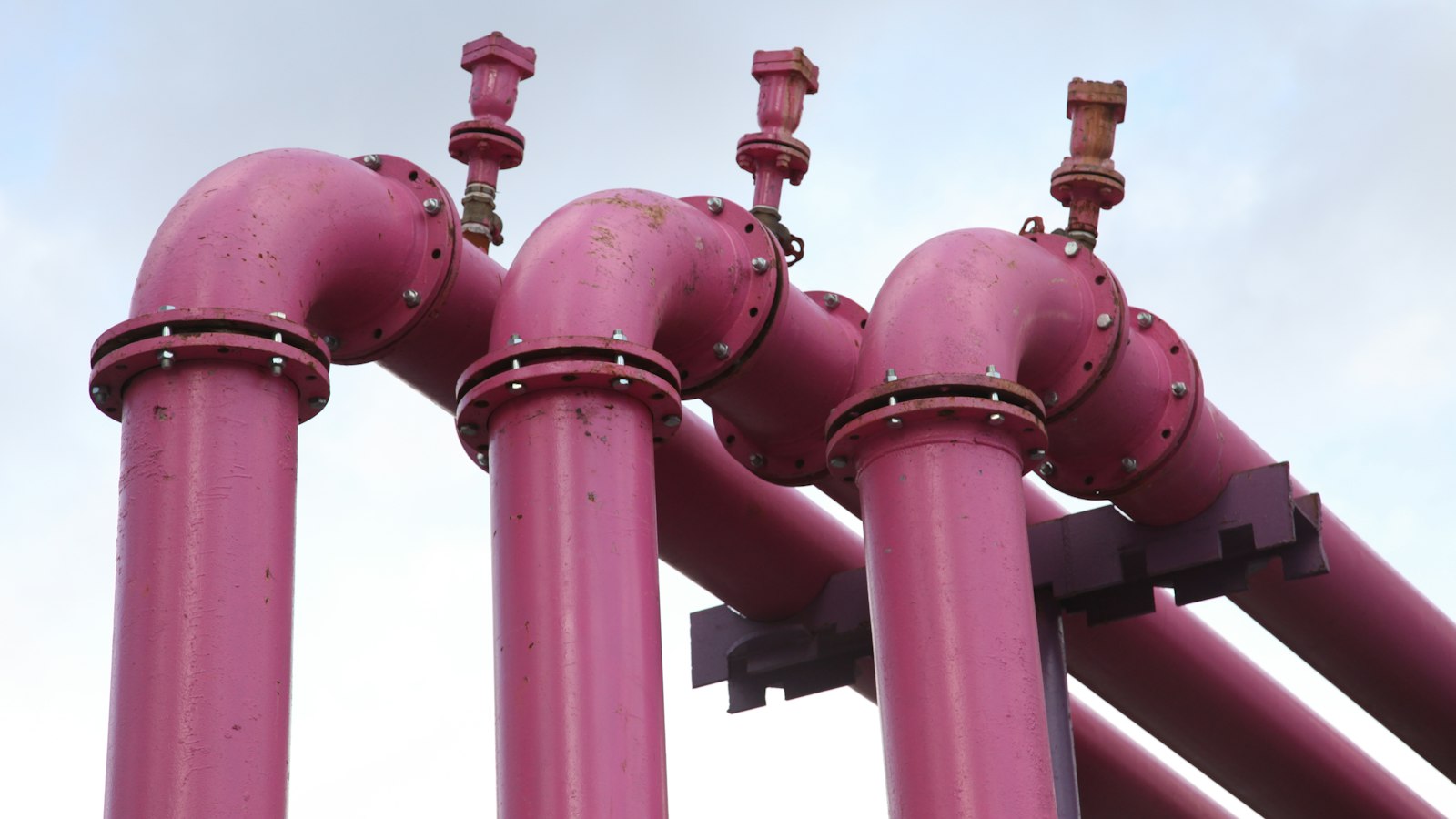
FRP pipe specifications define what a fibre-reinforced plastic pipe must withstand and how it must be built. For chemical service the essential points are the medium and its concentration, design temperature, internal pressure, vacuum, diameter, joint type and the design standard. The resin and corrosion barrier decide chemical resistance, and the glass structure decides strength. Everything here concerns unlined FRP pipe: how it is made, what to specify, how to choose a resin and what to put in an enquiry.
How FRP pipe is built
An FRP pipe wall for chemical service has three layers, each with a different job.
| Layer | What it is | What it does |
|---|---|---|
| Corrosion barrier (inner) | Resin-rich surface veil backed by chopped strand mat | Carries the chemical resistance; keeps the medium away from the structural glass |
| Structural wall | Continuous glass fibre and resin | Carries pressure, vacuum and piping loads |
| Outer surface | Resin-rich layer, often with UV protection | Protects against weather and handling damage |
Two manufacturing methods are common. Filament winding places continuous glass rovings on a rotating mandrel at a controlled angle, which gives a strong and repeatable wall for straight pipe. Hand lay-up, also called contact moulding, builds the laminate by hand from mat and woven roving. It is used for fittings, special shapes and repairs.
Glass fibre on its own has poor resistance to many chemicals, alkalis and fluorides in particular. If the corrosion barrier is breached, the medium wicks along the fibres and the structural wall degrades from inside. The barrier is the part of the specification that keeps the pipe in service.
The points to specify
Service medium. Name every component with its concentration, including traces, upset conditions and cleaning chemicals. Resin selection depends on the worst case, not the average.
Temperature. Give normal, maximum and any steam-out or cleaning temperature. Resin properties fall as temperature approaches the resin’s limit.
Pressure. State design pressure, test pressure and any surge or water hammer. FRP is less forgiving of pressure spikes than steel.
Vacuum. State full or partial vacuum, even if it occurs only on draining or cool-down. Large thin-walled pipe is often governed by buckling under external pressure, not by internal pressure.
Size. Nominal diameter and, for long runs, the expected support spacing.
Joints. Common options are flanged, butt-and-strap laminated, and adhesive-bonded spigot and socket. Flanged joints need full-face gaskets and controlled bolt torque. Laminated joints need suitable site conditions to cure.
Supports and expansion. FRP has a lower stiffness and a higher thermal expansion than steel, so it usually needs closer supports and planned expansion.
Special requirements. Electrical conductivity for flammable atmospheres, fire performance, UV exposure, burial, and tolerances for mating with other equipment.
Design standards
GreyTec’s FRP pipe page lists design to British, American and German standards. The ones that matter most for pipe:
- BS 7159 is the UK code of practice for the design and construction of GRP piping systems for individual plants or sites.
- BS 6464 specifies reinforced plastics pipes, fittings and joints for process plants.
- DIN 16965 covers wound glass-fibre reinforced plastic pipes, and DIN 16966 the matching fittings and joints.
- AWWA C950 and Manual M45 cover fibreglass pressure pipe and its design, mainly in water service.
- BS EN 13121, BS 4994 and ASME RTP-1 cover GRP tanks, vessels and corrosion-resistant equipment, and apply to the vessels and nozzles a pipe system connects to.
Name the standard your plant requires. If a project specification calls for a different code for piping, raise it at enquiry stage so the supplier can confirm whether it can design to it.
Choosing the resin
Resin choice is the main chemical decision. At overview level:
| Resin family | Typical use | Limits to check |
|---|---|---|
| Isophthalic polyester | Water, mild chemicals, ducting | Poorer in alkalis and stronger acids |
| Bisphenol-A epoxy vinyl ester | General chemical service: many acids, salts, some alkalis | Temperature limit varies by medium |
| Novolac epoxy vinyl ester | Higher temperatures, solvents, oxidising media such as chlorine | More brittle; check against the duty |
| Brominated vinyl ester | Where fire retardance is required, and chlorine and bleach duties | Check resin data for each medium |
| Epoxy | Pressure pipe in water and mild chemicals | Less suited to strong oxidisers |
GreyTec’s FRP manhole and cover datasheets specify vinyl ester equivalent to two of these: Derakane 411, a bisphenol-A epoxy vinyl ester, and Derakane 470, a novolac epoxy vinyl ester.
The veil in the corrosion barrier matters too. Published resin guidance recommends synthetic or carbon veils in place of glass veil for alkaline service at elevated temperature and for hydrofluoric acid, and warns that carbon veil is not suitable in sodium hypochlorite. The detailed resin-by-medium picture is a chemical resistance question and needs checking against the actual concentration and temperature.
Where no resin is good enough, the answer is a thermoplastic or fluoropolymer liner inside the FRP. GreyTec covers that option on its fluoropolymer lined FRP pipes and fittings page. The difference between the terms GRP and FRP is explained in this article.
What to put in an enquiry
- Medium, with concentrations of every component, traces and cleaning agents
- Normal and maximum temperature, and any steam-out temperature
- Design pressure, test pressure, and any surge or vacuum case
- Nominal diameters and approximate lengths
- Fittings required: elbows, tees, reducers, flanges, nozzles
- Joint type and flange drilling standard
- Design standard and any project specification
- Installation: above ground, buried, indoor, outdoor
- Special needs: conductivity, fire, UV, inspection and test requirements
Where FRP pipe specifications go wrong
- Pressure given, vacuum missed. The pipe passes its pressure test and collapses on the first fast drain.
- Surge not stated. A pump trip or fast-closing valve creates a spike well above design pressure.
- Resin chosen for the main medium only. Cleaning chemicals or an upset condition attack the corrosion barrier.
- Over-torqued flanges. FRP flanges crack when bolted like steel flanges. Torque values and gasket type must come from the pipe supplier.
- Point loads at supports. Narrow or unpadded supports wear or crack the pipe wall.
- Field joints made in poor conditions. Cold or humid weather affects cure, and the joint becomes the weak point.
What GreyTec can supply
GreyTec’s FRP equipment range includes tanks, columns, scrubbers, ducting and headers, and fluoropolymer lined and coated equipment. Its pipes and fittings range covers FRP pipes and fittings with flanges, manholes, sheets and backing rings. GreyTec’s FRP pipe page, which covers both pure GRP and dual laminate pipe, lists diameters from 25 to 3,600 mm (larger on request), filament winding or hand lay-up, and working pressures of 6 to 16 bar.
The page gives one working pressure range for both builds, so state your design pressure, test pressure and temperature in the enquiry and GreyTec will confirm the build that meets them. GreyTec’s FRP pages state certification to ISO 9001:2015, ISO 14001:2015 and ISO 45001:2018, and PED and CE marking on FRP equipment.
FAQ
What pressure can FRP pipe take?
It depends on diameter, wall build, resin and temperature, so it is set by design for each project. Give the supplier your design pressure, test pressure and any surge case, and ask for the rating at your design temperature.
Is filament wound pipe better than hand lay-up?
For straight pipe, filament winding gives a more consistent wall and higher strength for the same thickness. Hand lay-up is used for fittings and special shapes. Most systems use both.
What is a corrosion barrier in FRP pipe?
It is the resin-rich inner layer, with a surface veil and chopped strand mat, that keeps the medium away from the structural glass. Its resin and thickness decide how long the pipe lasts in chemical service.
When does FRP pipe need a liner?
When no resin is rated for the medium at the required temperature, or when the medium attacks glass. A thermoplastic or fluoropolymer liner then carries the chemistry and the FRP carries the load.
To have an FRP pipe specification checked against your process, send it to GreyTec.