

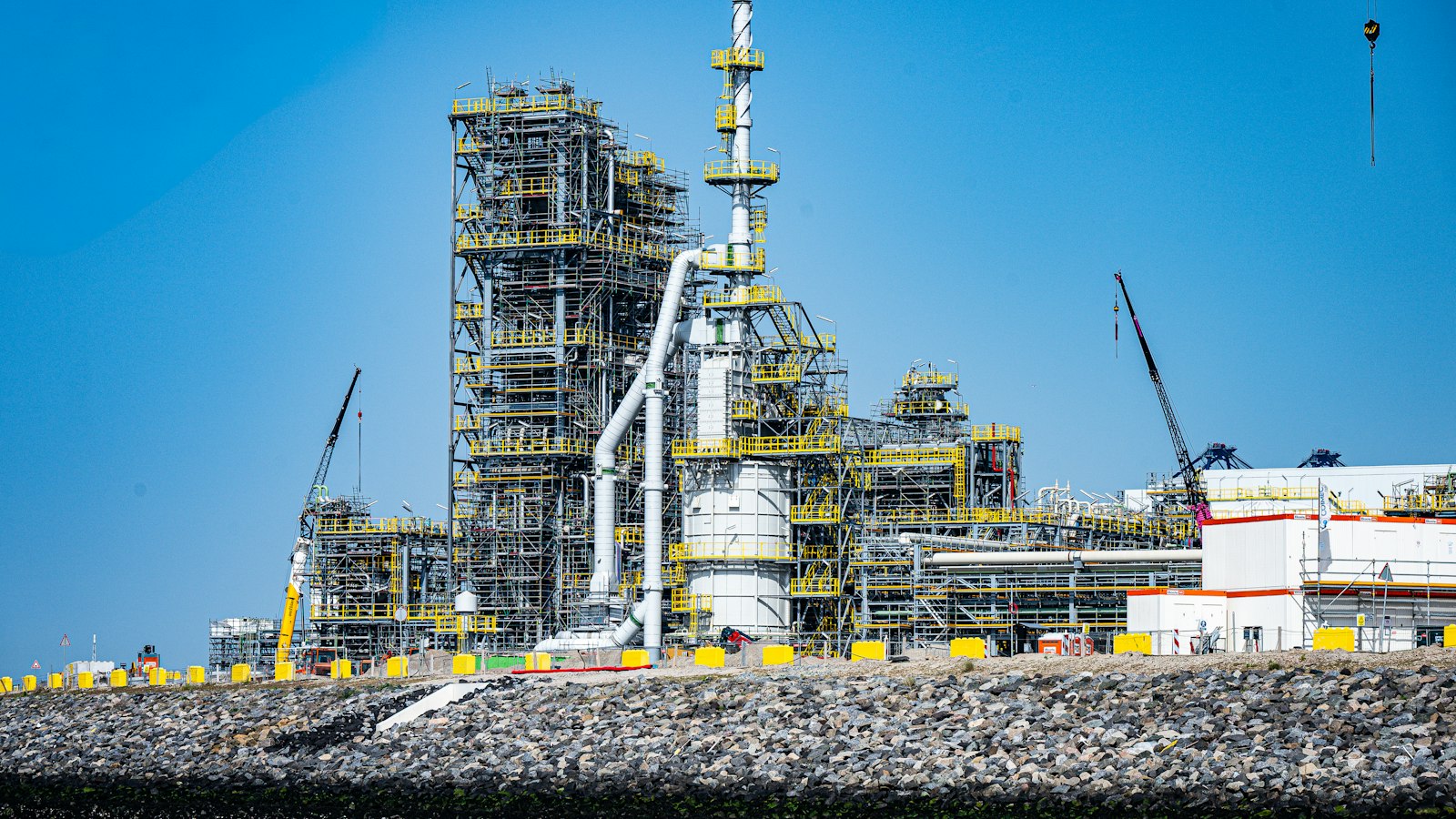
What is a chlor alkali plant? It is a chemical plant that passes direct current through sodium chloride brine to make chlorine, caustic soda (sodium hydroxide) and hydrogen. Around the cell room sit the sections that treat the brine, cool, dry, compress and liquefy the chlorine, concentrate the caustic, handle the hydrogen, and often make hydrochloric acid and absorb vent gas. Each section has its own corrosive medium, and that medium decides the material of every pipe, valve, tank and heat exchanger in it, so this overview goes area by area.
What the plant makes, and in what ratio
The overall reaction is 2 NaCl + 2 H2O → Cl2 + H2 + 2 NaOH. The ratio is fixed by chemistry. For every tonne of chlorine, the cells produce about 1.13 tonnes of sodium hydroxide (100 percent basis) and about 28 kg of hydrogen. A plant cannot make more chlorine without also making the caustic and hydrogen, so all three product lines are sized together.
Three cell technologies exist: membrane, diaphragm and mercury. The membrane cell is now the most common. It produces caustic at roughly 32 percent concentration, which many plants evaporate to 50 percent for sale.
The three products attack equipment in opposite ways. Wet chlorine is oxidising and acidic, caustic is strongly alkaline and often hot, and brine carries a high chloride load. A material that is right for one section can fail quickly in the next, which is why material selection in a chlor-alkali plant is done section by section.
Plant areas at a glance
| Plant area | Main media | Typical corrosion or failure problem |
|---|---|---|
| Brine preparation and treatment | Saturated sodium chloride brine, acid and alkali for pH control, precipitated solids | Chloride pitting and crevice attack on steels, scaling, crystal build-up, erosion by solids |
| Depleted brine return and dechlorination | Hot depleted brine with dissolved chlorine, acid | Oxidising chloride attack, harsher than fresh brine |
| Cell room | Wet chlorine at cell temperature, brine, caustic, hydrogen | Wet chlorine attack on most metals, leaks at headers and joints |
| Chlorine cooling | Wet chlorine gas, chlorine water condensate | Rapid attack on carbon steel and stainless steel |
| Chlorine drying | Concentrated and weakened sulfuric acid, chlorine moving from wet to dry | Heat of absorption, corrosion where the acid weakens |
| Compression and liquefaction | Dry chlorine gas and liquid, non-condensable gases | Corrosion if moisture enters, leaks at stems and flanges, hydrogen enrichment in tail gas |
| Caustic soda handling and evaporation | Sodium hydroxide from about 32 to 50 percent, hot | Caustic cracking of carbon steel at temperature, attack on some plastics |
| Hydrogen | Wet hydrogen with caustic mist | Caustic carry-over, leak tightness |
| Hydrochloric acid | Hydrogen chloride gas and hydrochloric acid | Attack on almost all common metals |
| Vent and tail gas treatment | Chlorine in air, caustic, sodium hypochlorite | Hypochlorite attack, heat released during absorption |
Brine preparation and the cell room
Solid salt is dissolved to make saturated brine. The brine is then purified: calcium and magnesium are precipitated and filtered out, and in membrane plants a final ion exchange step polishes the brine before it reaches the cells. Hardness left in the brine damages the membranes, so this section runs with strict quality control. Equipment here sees hot chloride solution, acid and caustic dosing points, and slurries of precipitated solids.
Brine leaves the cells partly depleted and carrying dissolved chlorine. It is dechlorinated and returned to the saturators. That return line is the harder service of the two, because it combines chloride, an oxidiser and often low pH.
The cell room houses the electrolysers. Chlorine forms at the anode and leaves saturated with water vapour at close to cell temperature. Caustic and hydrogen form at the cathode side. Pipework around the cells carries all four media in close quarters: brine in, depleted brine out, wet chlorine to the chlorine headers, caustic and hydrogen to their own systems.
The chlorine line: cooling, drying, compression and liquefaction
Hot wet chlorine is cooled in stages, first with cooling water and then often with chilled water. Most of the water condenses out as chlorine water, one of the most corrosive streams in the plant. Titanium is widely used on this wet side. It must never be used in dry chlorine, where it can ignite.
The cooled gas is dried by contact with concentrated sulfuric acid in packed towers. Strong acid enters the last stage and weakened acid leaves the first. Each tower usually has its own acid circulation loop with a cooler, because water absorption releases heat.
Dry chlorine is compressed and then liquefied by cooling. At this point the gas no longer attacks carbon steel at ambient temperature, so the dry section uses very different materials from the wet section upstream. Gases that do not condense, including hydrogen, oxygen and nitrogen, collect in the tail gas.
As more chlorine is liquefied, the hydrogen fraction in the tail gas rises, and plants control the liquefaction rate and gas composition to keep it below the explosive range. The tail gas goes to hydrochloric acid synthesis, hypochlorite production or absorption.
Caustic soda, hydrogen and hydrochloric acid
Caustic soda from membrane cells is filtered, cooled or evaporated, stored and loaded. Hot concentrated caustic causes stress corrosion cracking in carbon steel above certain temperature and concentration combinations, and it attacks some polymers that are excellent in acid. Lines that freeze in winter need heat tracing, which brings its own risk of local overheating on lined pipe.
Hydrogen leaves the cells wet and carries caustic mist. It is cooled, scrubbed and compressed. It is used as fuel, sold, or burned with chlorine to make hydrogen chloride.
Many chlor-alkali sites make hydrochloric acid. Hydrogen and chlorine react in a synthesis unit, and the hydrogen chloride gas is absorbed in water. Absorption releases a lot of heat, so the absorber must be cooled. Graphite is the common material for this service because it resists hydrochloric acid and conducts heat well.
Vent and tail gas absorption
Every chlor-alkali plant needs a system to absorb chlorine from vents, tail gas and process upsets. Caustic soda is the usual absorbent. It reacts with chlorine to form sodium hypochlorite and salt.
The system is sized for the worst credible release, which can be the full cell room output for a limited time, not only the normal vent flow. The reaction is strongly exothermic, so liquor temperature and the remaining caustic strength both matter. Scrubber columns, ducting, tanks and pumps here must resist caustic and hypochlorite together.
Where material selection goes wrong in chlor-alkali plants
Most repeat failures in these plants trace back to a boundary that moved or a material carried across one.
- The wet and dry boundary shifts. Moisture enters the dry chlorine section after maintenance or during upsets. Carbon steel that was fine in dry chlorine then corrodes quickly.
- Titanium crosses into dry service. A part that suits wet chlorine is installed downstream of the drying section. In dry chlorine, titanium can ignite.
- Feed and return brine share one specification. The return line carries dissolved chlorine and fails first.
- Acid-grade materials go into caustic service. A lining chosen for hydrochloric acid is reused on a caustic line without a check.
- Gaskets, seats and diaphragms are overlooked. The pipe or valve lining is correct but the soft parts are not, and they leak first.
- Spares drift from the original specification. A replacement valve or spool arrives with a different lining or seat material.
A plant-wide material register by area and medium, checked at every spare part order, prevents most of these. Operating and emergency arrangements for every area are set by the plant’s own safety procedures and the equipment suppliers’ documentation.
What GreyTec can supply
GreyTec supplies equipment and engineering for corrosive applications and lists chlor-alkali among the industries it serves. Its lined valve range covers PFA lined butterfly, ball, ball check, swing check, diaphragm, globe and plug valves, with lining options across the range including PFA, FEP, PVDF, ETFE, ECTFE and PPH. GreyTec also offers fluoropolymer lined metal and FRP pipe, FRP tanks and scrubbers, and graphite and silicon carbide heat exchangers.
The lined ball valve page notes that its lined valves are widely used in chlor-alkali plants on hydrochloric acid and caustic soda. Through its partner Ecarb Technologies, a Milan-based EPC contractor specialising in chlor-alkali technologies, GreyTec can also offer process packages for brine treatment, chlorine drying, compression and liquefaction, emergency chlorine scrubbing, caustic concentration and HCl synthesis.
FAQ
What are the main products of a chlor alkali plant?
Chlorine, caustic soda and hydrogen, in a fixed ratio of about 1.13 tonnes of caustic and 28 kg of hydrogen per tonne of chlorine. Many sites also make hydrochloric acid and sodium hypochlorite from part of that output.
What is the difference between membrane, diaphragm and mercury cells?
They separate the anode and cathode products in different ways. Membrane cells use an ion exchange membrane and produce about 32 percent caustic of high purity. Diaphragm cells give weaker caustic with more salt in it, and mercury cells use a mercury cathode, which raises serious environmental issues.
Why is wet chlorine so much more corrosive than dry chlorine?
With water present, chlorine forms hydrochloric and hypochlorous acids, which attack carbon steel and stainless steel. Dry chlorine at ambient temperature does not corrode carbon steel. That is why the drying section is the main material boundary in the plant.
Which plant areas need lined or non-metallic equipment?
Typically brine treatment and return, the wet chlorine section, hydrochloric acid, the drying acid loops and the vent absorption system. The dry chlorine section normally uses metals, but the choice must follow the plant’s own standards and the applicable industry guidance.
For a technical review of equipment for any of these areas, send your duty conditions to GreyTec.