

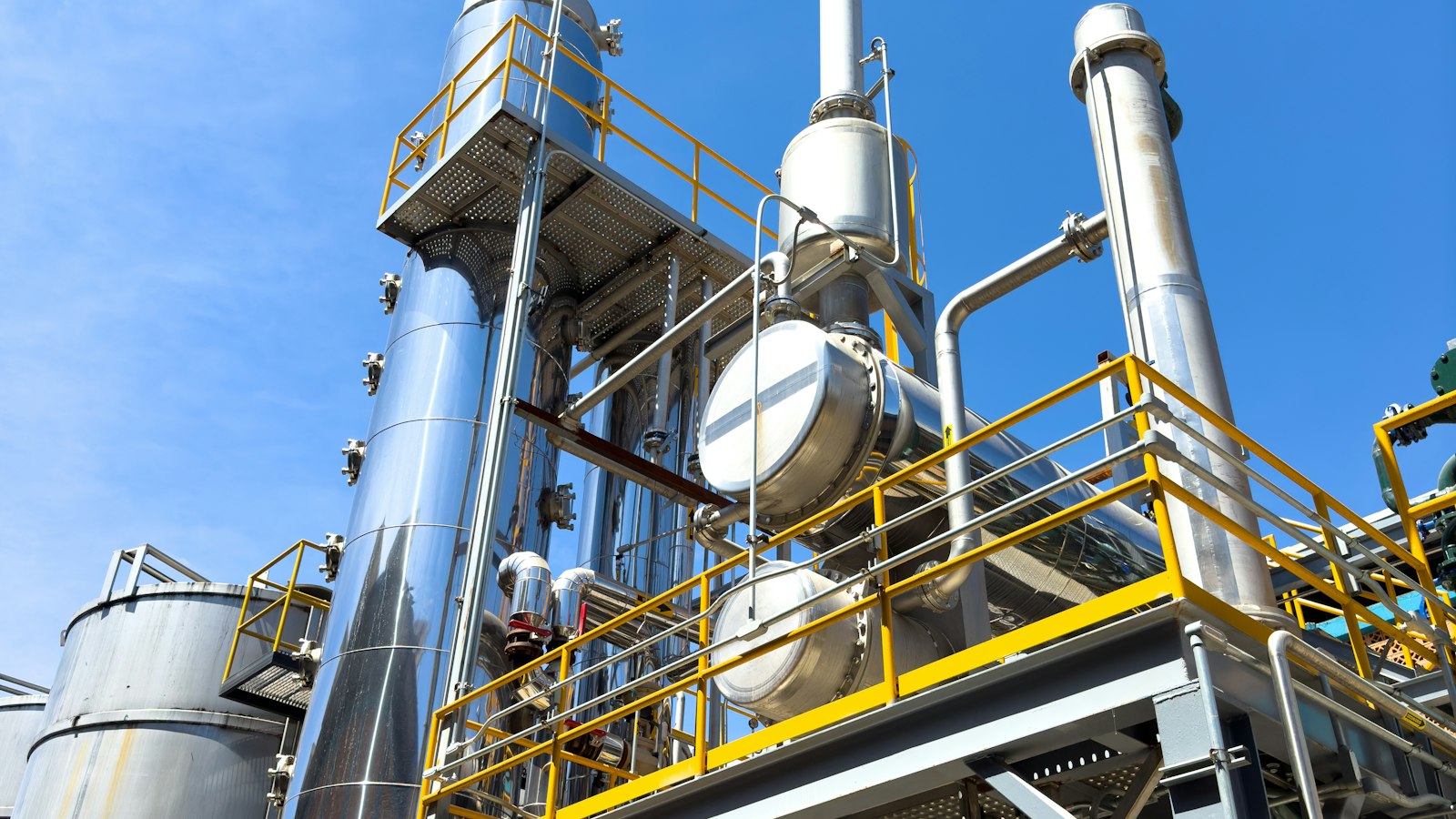
Chlorine scrubber system design is about one number above all others: the largest quantity of chlorine the system must absorb, and how fast. The system collects chlorine from process vents, tail gas and emergency relief, and absorbs it, almost always in caustic soda solution. The design then follows from that case: how much caustic must be available, how much heat the reaction releases and which contactor type handles the flow. It also sets which materials survive caustic and hypochlorite together, and what keeps the system running when the plant itself is in trouble.
What the system has to handle
A chlorine absorption system usually serves two kinds of load.
Continuous or routine loads. Tail gas from liquefaction, purge streams, vents from tanks and loading, and gas released during maintenance. Flows are modest and chlorine concentration varies widely.
Upset and emergency loads. Relief from pressure safety valves, compressor trips and cell room upsets. In a chlor-alkali plant, guidance from Euro Chlor and the Chlorine Institute asks the designer to consider the maximum probable flow, which can mean the whole cell room output vented for a limited time.
The design inputs to fix early:
- Maximum chlorine flow in kg/h for each credible case, and its duration
- Total gas flow and chlorine concentration, including air or nitrogen dilution
- Gas temperature, and whether liquid chlorine can reach the system
- Other components: hydrogen, carbon dioxide, hydrogen chloride, moisture
- Allowable chlorine in the outlet gas
- Whether the system must run on standby power
Caustic demand and heat: a worked example
Chlorine reacts with sodium hydroxide to form sodium hypochlorite, salt and water:
Cl2 + 2 NaOH → NaOCl + NaCl + H2O
By mass, each kilogram of chlorine needs about 1.13 kg of sodium hydroxide (100 percent basis). The reaction is strongly exothermic. Chlorine Institute Pamphlet 89 gives a heat release of roughly 1.45 MJ per kilogram of gaseous chlorine absorbed.
Hypothetical example, for illustration only. A relief case of 2,000 kg/h of chlorine lasting one hour, with a 10 percent caustic margin:
- Caustic demand: 2,000 × 1.13 × 1.1 ≈ 2,490 kg of NaOH (100 percent basis)
- As 20 percent solution: about 12.4 t of liquor, roughly 10 m3
- Heat release: 2,000 × 1.45 ≈ 2,900 MJ in the hour, an average of about 0.8 MW
Two lessons follow. First, the liquor inventory must be on hand before the release starts; it cannot be dosed in time. Second, the heat is large. Without cooling, liquor temperature climbs fast, and hot hypochlorite decomposes.
Choosing the scrubber type
| Scrubber type | Where it suits chlorine absorption | Limits |
|---|---|---|
| Packed bed tower | Continuous vents and emergency duty; high efficiency at moderate gas flow | Packing can foul with salt if liquor strength is wrong; pressure drop rises with flow |
| Venturi | High gas flows and sudden surges; can induce draught | Higher energy use; usually needs a second stage to reach low outlet chlorine |
| Spray tower | Large gas volumes with low pressure drop; tolerant of solids | Lower efficiency per stage than packing |
| Plate type | Good contact at steady flows; stages can be added | Less tolerant of large flow swings |
| Combination (for example venturi followed by packed bed) | Emergency systems that must take a surge and still meet a tight outlet limit | More equipment to maintain |
Many chlor-alkali emergency systems use two stages in series. The first takes the bulk of the chlorine and the heat. The second polishes the outlet gas and protects against breakthrough if the first stage liquor is spent.
Materials for the shell and internals
The system sees caustic soda at the start of a release, sodium hypochlorite as it proceeds, and hot liquor throughout. Materials must handle all three.
- Shell and ducting. FRP with a suitable resin and corrosion barrier, or dual laminate with a thermoplastic or fluoropolymer liner, is common. Published resin guides show that resin choice matters: some epoxy vinyl ester resins are specifically recommended for chlorine and bleach environments.
- Internals. Packing supports, distributors, mist eliminators and packing must resist hot hypochlorite. Check each part, not only the shell.
- Liquor tanks, pumps, valves and piping. The same chemistry applies. Lined valves and lined pipe are common on the circulation loop.
- Coolers. If the liquor is cooled, the cooler sees hot hypochlorite on one side and must be selected for it.
Redundancy and reliability
An emergency system is only useful if it works when everything else has failed.
- Power. Fans and circulation pumps on a non-interruptible or standby supply. Some designs use a gravity-fed caustic head tank so liquor flows without pumps.
- Spare capacity. Duty and standby pumps, and two fans where the fan is critical.
- Liquor condition. Monitoring of remaining caustic strength and liquor temperature, so a spent or overheated charge is seen before it is needed.
- Testing. A design that allows regular functional testing without venting chlorine.
Questions to ask a supplier:
- Which design case did you size for, and for how long?
- What outlet chlorine concentration does the supplier commit to at that case?
- How is reaction heat handled, and what is the maximum liquor temperature?
- Which materials are used for the shell, liner, packing, distributor and mist eliminator, and are they rated for hot hypochlorite?
- What happens if power is lost during a release?
- How is caustic strength monitored and replenished?
Where chlorine scrubber systems go wrong
- Sized for normal vents only. The system copes every day and fails during the one event it exists for.
- Heat ignored. Liquor overheats, hypochlorite decomposes, and chlorine breaks through.
- Caustic allowed to run down. Once the caustic is consumed, the pH falls and chlorine passes straight through. Salt can also precipitate and block packing.
- Carbon dioxide uptake on standby. Air drawn through the system slowly converts caustic to carbonate, so the available charge is smaller than the tank level suggests.
- Materials chosen for caustic only. Parts that suit caustic can fail quickly in hot hypochlorite.
These are design and specification points. Testing and operating the system in an emergency are governed by the plant’s own safety procedures and the supplier’s documentation.
What GreyTec can supply
GreyTec supplies FRP scrubbers in packed bed, venturi, spray tower, plate-type and combination designs. Its scrubber page states they handle emissions including hydrochloric acid fumes, chlorine, ammonia, sulfur dioxide and nitrogen dioxide, and that design is supported by an in-house design team and laboratory. Through its emission control consultancy and engineering, GreyTec also works on wet gas scrubbers, vapour recovery, thermal oxidation and De-NOx.
Through its partner Ecarb Technologies, GreyTec can also offer complete emergency hypochlorite units and chlorine scrubbers for chlor-alkali plants. Lined valves for the circulation loop are covered in valves for chlorine service.
FAQ
Why is caustic soda the usual absorbent for chlorine?
It reacts quickly and completely with chlorine, and the product, sodium hypochlorite, can often be used or sold. Water alone absorbs far less chlorine and would not protect against a large release.
What caustic strength is used in a chlorine scrubber?
It is a design choice. Stronger caustic holds more capacity per cubic metre, but very strong caustic raises the risk of salt precipitation as it reacts. Moderate strengths in the region of 20 percent are common; confirm the figure for your design case.
What happens when the caustic is used up?
The liquor turns acidic, hypochlorite starts to decompose and chlorine passes through to the outlet. Monitoring caustic strength and sizing the charge with margin are the two defences.
Is one packed tower enough for an emergency system?
Sometimes, but many plants use two stages in series. The first absorbs the bulk and the heat, and the second keeps outlet chlorine low if the first stage is overloaded.
To discuss a chlorine absorption system for your plant, send the design case to GreyTec.