

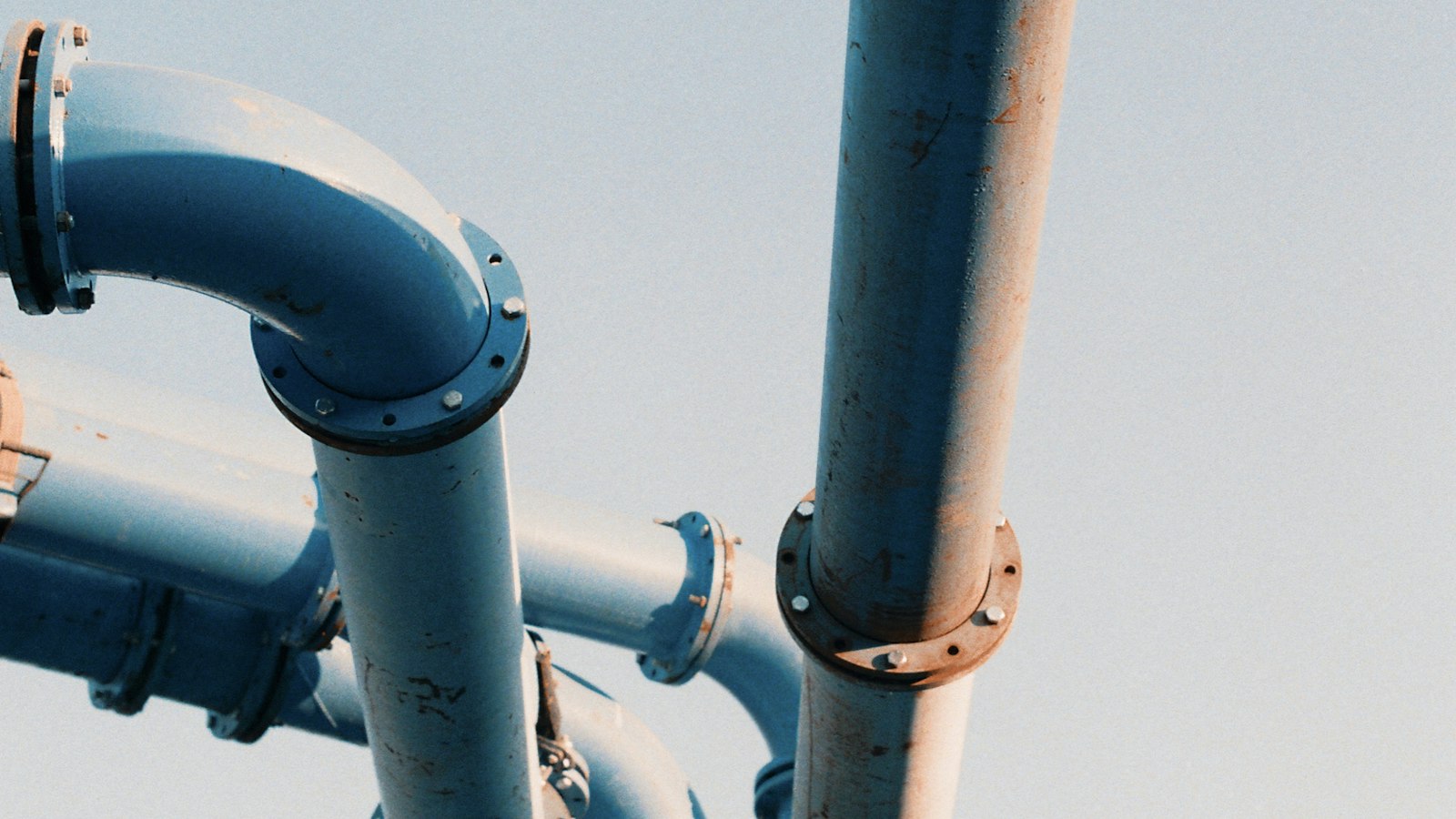
Brine piping in a chlor-alkali plant carries saturated sodium chloride solution to the cells and brings depleted brine back for dechlorination and resaturation. Feed brine is a warm, concentrated chloride solution that pits stainless steel and corrodes carbon steel, while return brine adds dissolved chlorine and often a low pH. Fluoropolymer lined steel and fluoropolymer lined FRP are the usual long-term answers, with the liner chosen for the temperature and chlorine content of each line.
Where brine lines run in a chlor-alkali plant
The brine circuit is a closed loop. Salt is dissolved in saturators, the brine is treated and polished, fed to the cells, and returned depleted. Each part of the loop puts a different load on the pipe.
| Line segment | What it carries | What makes it hard on pipe |
|---|---|---|
| Saturator to primary treatment | Saturated raw brine with hardness and suspended solids | Solids, scaling, chloride attack |
| Primary treatment and filtration | Brine with precipitated calcium and magnesium compounds, alkaline dosing | Abrasive slurry, pH swings |
| Secondary treatment to cell feed | Polished brine, often heated, acid dosing for pH | Hot chloride, acid injection points |
| Cell outlet to dechlorination | Depleted brine with dissolved chlorine at near cell temperature | Oxidiser plus chloride plus heat |
| Dechlorinated return to saturators | Depleted brine after chlorine removal, pH adjusted | Residual chlorine if dechlorination upsets, crystals where brine cools |
The cell outlet line is the most demanding segment. It is hot, it carries chlorine, and it is often acidic. Treat it as its own line class rather than as part of the feed brine specification.
Why brine lines fail
Chloride attack on steel. Concentrated chloride brine breaks down the passive film on stainless steel, causing pitting and crevice corrosion under gaskets and deposits. Austenitic stainless steel also becomes prone to chloride stress corrosion cracking as temperature rises. Carbon steel corrodes generally and contaminates the brine with iron, which the cell membranes do not tolerate.
Chlorine carried in the returning brine. Dissolved chlorine and hypochlorite make the depleted brine oxidising. This speeds up attack on metals and on some elastomers and plastics that are fine in plain brine.
Temperature. Brine is heated before the cells and leaves them close to cell temperature. Every polymer liner has a temperature limit that shrinks as chlorine content and pressure rise, so the hot return line usually sets the liner choice.
Crystal build-up. Saturated brine deposits salt wherever it cools or evaporates. Dead legs, instrument tappings, valve cavities and unheated low points collect crystals. Crystals block flow, damage seats and hold corrosive liquid against metal.
Erosion. Solids from primary treatment and filter breakthrough wear elbows, reducers and valve trims, especially where velocity is high.
Material options for brine piping
| Material | Where it fits in brine service | Limits that matter |
|---|---|---|
| PTFE or PFA lined carbon steel | All segments, including hot chlorinated return brine | Liner temperature and vacuum rating, flange face damage, permeation over long service |
| PVDF lined carbon steel | Feed and return brine at moderate temperature | Lower temperature limit than PTFE or PFA when chlorine is present |
| FEP lined carbon steel | Feed brine and moderate return service | Lower temperature limit than PFA |
| Fluoropolymer lined FRP (dual laminate) | Large-bore headers, saturator lines, low-pressure return lines | Lower pressure rating than steel, needs good support and protection from impact |
| Carbon steel or stainless steel, unlined | Not a long-term answer in chlorinated brine | Pitting, cracking and iron contamination |
Published data gives a sense of the margins. Arkema’s chemical resistance chart for its PVDF homopolymer lists brine to 140 °C but chlorinated acidic brine only to 95 °C, for solid resin components. Lined components carry lower limits than solid resin, so check the actual liner rating against your concentration, chlorine content and temperature.
Lined FRP becomes attractive at large diameters, where lined steel becomes heavy and expensive, and where pressures are modest. Lined steel is the safer choice where the line sees higher pressure, vacuum, piping loads or a risk of mechanical damage.
Valve choice where crystals can collect
Valves are where brine systems usually give trouble first. A standard ball valve has a cavity between the ball and the body. Brine trapped there can crystallise when the line cools, which raises operating torque and damages seats on the next stroke.
Options that reduce this risk:
- Lined plug valves with zero cavity. The plug sits directly in the lining, so process fluid has nowhere to collect and crystallise.
- Diaphragm valves. The flow path is smooth and there is no cavity, which suits throttling and dosing duties.
- Full-port designs in slurry lines, to cut erosion and blockage.
- Drain and flush connections at low points, specified at design stage rather than added later.
What to inspect on brine lines
At planned shutdowns, the following give the earliest warning:
- Vent holes on lined steel pipe. Wetness or staining at a vent hole points to liner damage or permeation.
- Liner flares at flange faces. Look for cracks, cold flow and cuts from over-tightening or misalignment.
- Spark testing of liners where lines are opened, to find pinholes before they become leaks.
- External corrosion at flanges and supports, which often signals a slow leak.
- FRP inner surfaces. Look for blisters, discolouration, softening or exposed fibres.
- Valve seats and cavities for crystal deposits and seat damage.
- Elbows and reducers in slurry lines for erosion.
Where brine piping goes wrong
- One specification for feed and return. The return line sees chlorine and higher temperature. It fails years before the feed line if both share a specification.
- Dead legs left in place. Old branches and bypasses fill with stagnant brine, crystallise and corrode.
- Over-torqued flanges on lined pipe. The liner flare is the gasket face. Excess torque cracks or extrudes it.
- Steam-out beyond the liner rating. Cleaning with steam can exceed the temperature limit of PVDF or FEP liners.
- Vacuum during draining. A line that cools or drains quickly can pull vacuum. Liners not rated for it can collapse.
- Unheated low points. Brine cools, salt drops out, and the line blocks.
- Vent holes blocked by paint or insulation. Blasting, painting and lagging close the small vent holes on lined pipe, and the early warning of liner damage is lost. Vent extenders or vent collars keep them open under insulation.
What GreyTec can supply
GreyTec offers fluoropolymer lined metal pipes and fittings from DN25 to DN600 (1 to 24 inch) in carbon steel, SS304, SS316 and other alloys, with PTFE, PFA, FEP or PVDF liners and ANSI 150, ANSI 300 or DIN connections. For larger or low-pressure lines it offers fluoropolymer lined FRP pipes and fittings from 25 to 3,600 mm, with a minimum 2.5 mm liner, spark-tested welds and 6 to 16 bar working pressure. GreyTec’s lined metal pipe is tested to ASTM F1545, the specification for plastic-lined ferrous pipe that also sets venting requirements, and its page states the design handles full vacuum through secure liner anchoring.
Its lined plug valve has zero cavity between plug and lining, so process fluid cannot collect and crystallise. Through its partner Ecarb Technologies, GreyTec can also supply complete brine treatment packages covering saturation, filtration, secondary purification and dechlorination.
FAQ
Can stainless steel be used for brine piping?
Not for long-term service in chlor-alkali brine. Stainless steel pits in concentrated chloride, risks stress corrosion cracking as temperature rises, and is attacked faster by the dissolved chlorine in return brine.
Is a PVDF liner suitable for chlorinated brine?
Often, at moderate temperature. Published PVDF data shows a clearly lower temperature limit in chlorinated acidic brine than in plain brine. Check the liner rating against the actual chlorine content and temperature, or ask GreyTec to check it.
What causes salt blockages in brine lines?
Saturated brine that cools or evaporates. Blockages form in dead legs, instrument tappings, valve cavities and unheated low points. Removing dead legs, heating low points and using cavity-free valves reduces them.
When should lined brine pipe be inspected?
At each planned shutdown that opens the line, and whenever a vent hole shows wetness. Spark testing the liner when the line is open finds damage before it reaches the steel.
To have your brine line materials checked against actual duty conditions, send an enquiry to GreyTec.